










Kubernetes from day one
to running in production.

KCSP-certified Kubernetes partner in the Netherlands. From reviews and onboarding to fully managed clusters.


Trusted by teams in healthcare, fintech, logistics and government.

From public sector organizations to fast-growing software companies.

Intermax
NFIR
DICTU
Cofano
Hypotheekbond
Valicare
CCS
Funatic
IQ-EQ
Pengine
Guardian360
Fysicon
Alphatron Zorgverbinders
Ixolution
Koninklijke Notariële Beroepsorganisatie
UbiOps

100+

Clusters managed

40K+

Containers running

1000+

Nodes Ready

Amsterdam '23 → Paris '24 → London '25 → Amsterdam '26

Always learning,
sharing with our customers.

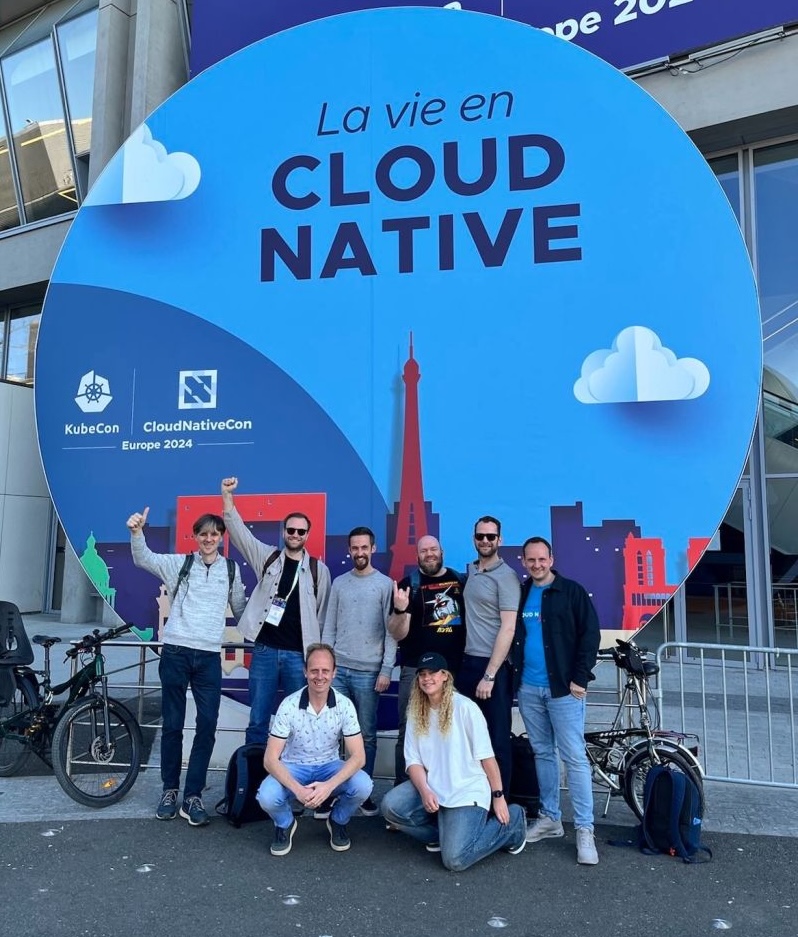
We work alongside development and infra teams every day. Attending KubeCon, learning on the job, and sharing that knowledge directly with our customers. That's how we stay sharp and keep your clusters up to date with the latest insights.

About us →
Guida team at KubeCon CloudNativeCon Europe 2024 in Paris

Why teams choose Guida

You focus on your product. We keep Kubernetes running.

Run anywhere
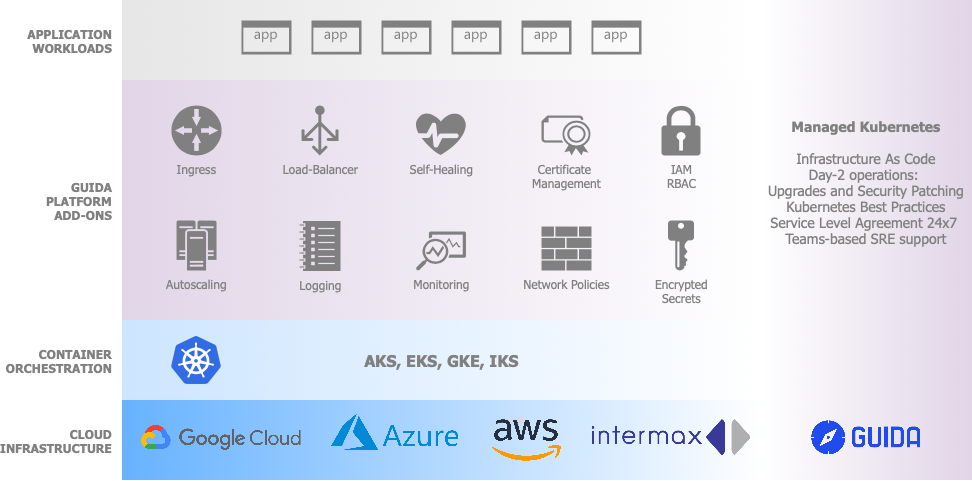
Intermax NL Cloud (IKS), Azure (AKS), AWS (EKS), Google Cloud (GKE), and private clouds (VMware, Nutanix, OpenStack). We run Kubernetes wherever your workloads need to be.
Batteries included from day one
Gateway API, Certificate management, Observability, GitOps, RBAC, and security policies. You get a production-ready and secure platform from the start.
Direct access to certified engineers
No support queues, no outsourced helpdesk. Every question and incident goes straight to a team of engineers who knows your setup.
Day-2 operations
Upgrades, security patches, certificate renewals, capacity planning, incident response. The unglamorous work that keeps production alive and secure.
EU-based. Sovereign.
Our team is based in The Netherlands. Your infrastructure stays in Europe or the Netherlands. We’re ISO27001 certified and GDPR-compliant.
Long-term partnership
We take time to understand your workloads, your team, and how you’ll use the platform. Including architecture guidance, tooling advice, and best-practices.

Services

What we do

We help development and platform teams get Kubernetes right, from initial design to running it at scale in production. Cloud-agnostic, fully managed, backed with a 24/7 SLA.

Guida Managed Kubernetes
Fully Managed Kubernetes.
Guida designs, builds, and operates production-grade clusters on hyperscalers, private clouds and on-premise datacenters. We tackle complex operational tasks so your team doesn’t have to.
Learn more →
Advisory & Architecture.
Not sure which cloud fits? How to structure multi-tenancy? Which tools to pick? As a KCSP, we’ve run clusters across different clouds and can tell you what works and what doesn’t.
Talk to us →
Site Reliability Engineering.
Our SREs handle monitoring, alerting, incident response, and root-cause analysis across Kubernetes, your cloud provider, and optionally your application stack. When something breaks, we’re already on it.
Learn more →
Guida Kubernetes Stack.
Gateway API, Prometheus, Grafana, Velero, Cert-Manager, FluxCD: pre-integrated, pre-hardened, and documented. A curated, solid and battle-tested stack built on trusted open-source projects.
See the stack →
Kubernetes Review.
We review your existing clusters: security posture, architecture, Day-2 readiness, and observability gaps. You get a clear written report with prioritized recommendations.
Learn more →
Kubernetes Onboarding.
Hands-on Kubernetes training delivered by the engineers who run your production clusters every day. Covering Kubernetes fundamentals, security, GitOps, and observability. Practical skills your team can use the next day.
Learn more →

Latest News

What's happening at Guida

Stay informed about our latest updates, announcements, and insights in the world of cloud-native and Kubernetes solutions.

articles

Managed Kubernetes vs. an In-House Platform Team: What It Really Costs

Running production Kubernetes in-house costs more than the cluster bill. The real cost is the platform team: enough engineers to cover a 24/7 on-call rotation, keep up with three Kubernetes releases a year, and patch CVEs across a dozen add-ons. For most organizations without a dedicated platform team, a managed Kubernetes provider is cheaper.

Read more →

articles

What AKS, EKS and GKE Don't Manage for You

Azure AKS, AWS EKS and Google GKE are “managed Kubernetes” in a narrow sense: the cloud provider runs the control plane. Most of what keeps a production cluster healthy is still yours. That includes node and add-on upgrades, ingress, certificates, monitoring, backups, security policies and incident response. This split, the shared responsibility model, is what teams moving to Kubernetes most often misunderstand.

Read more →

articles

Migrating from ingress-nginx to Gateway API: How to Plan It

A migration from ingress-nginx to Gateway API is less about YAML than about planning. Converting Ingress objects is largely automated. The real work is in three places: the annotations and configuration snippets nobody remembers adding the things ingress-nginx did for you implicitly the moment traffic moves to the new gateway Plan for those, and the migration is routine.

Read more →

articles

Gateway API vs. Ingress: What Changes and What Was Missing

Gateway API is the successor to the Kubernetes Ingress API. Ingress put everything in one object, extended with controller-specific annotations. Gateway API splits traffic configuration into separate resources for separate roles: the platform team runs the gateway, and application teams attach their routes to it.

Read more →

articles

Intermax Kubernetes Service (IKS) is Haven Compliant

Choosing the right Kubernetes hosting for your municipality or government organization is crucial. At Guida, we understand your needs for high availability, reliability, and compliance. That’s why our Managed Kubernetes Service (IKS) on the Intermax Cloud is Haven Compliant.

Read more →

articles

Being Cloud-Native: It’s How, Not Where

In the rapidly evolving tech landscape, the term “cloud-native” often gets associated with running applications exclusively in the public cloud. However, this is a common misconception. Being cloud-native is more about how you build and manage your applications than where they are hosted.

Read more →

We use cookies to improve your experience on our website. Learn more about our privacy policy.